Uzbekistan Introduces a 6% Special VAT Regime for Trade, Catering and Service Businesses
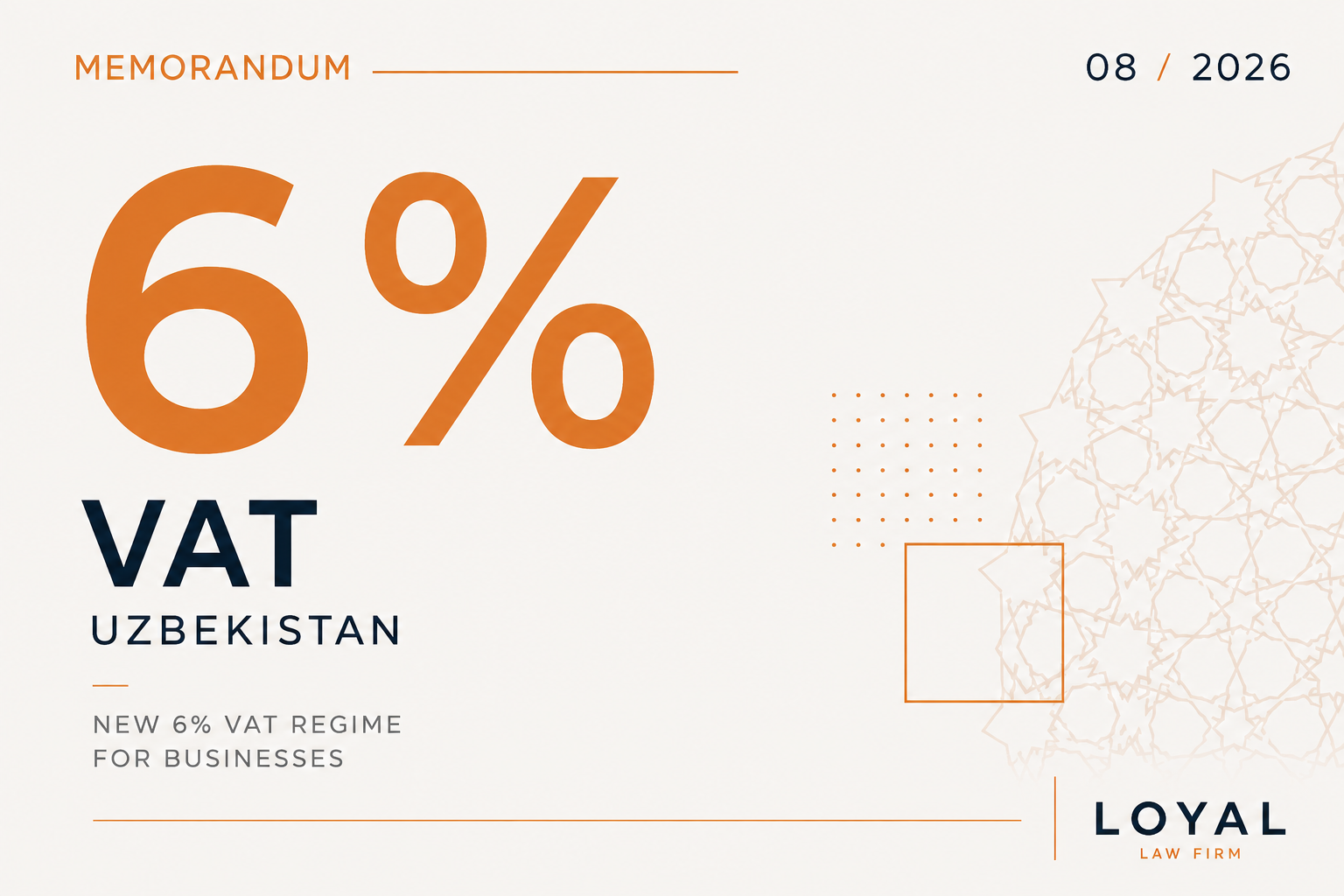
Under Presidential Decree of the Republic of Uzbekistan No. UP-100 dated 26 May 2026, from 1 June 2026 entrepreneurs whose principal business activity is catering, trade or the provision of services may voluntarily apply a special procedure for calculating and paying VAT. The regime will remain available until 1 January 2030.
Under the special regime, VAT is charged at 6% of turnover from the sale of goods and services, the corporate income tax rate is set at 0%, and the obligation to file corporate income tax returns is removed. At the same time, businesses applying the regime are not entitled to credit input VAT paid on purchases of goods and services.
This last condition is particularly important when deciding whether to switch to the new regime: a 6% VAT rate does not, by itself, mean that the special regime will necessarily be more financially advantageous than the standard VAT system.
What Changed from 1 June 2026
Before the introduction of the special mechanism, the standard VAT regime in Uzbekistan provided for a 12% VAT rate. This rate is established by Article 258 of the Tax Code of the Republic of Uzbekistan.
Decree No. UP-100 introduced an alternative for certain categories of entrepreneurs: they may either continue operating under the standard tax regime or voluntarily switch to the special regime with VAT at 6%. When presenting the reform, the official website of the President specifically stated that businesses are being given a choice between the new and the existing regime.
Accordingly, the transition is not automatic simply because a company is engaged in trade or provides services.
Who Can Apply the New Regime
The Decree grants the right to choose the special regime to entrepreneurs whose principal business activity is:
catering, trade or the provision of services.
The special regime applies for the period from 1 June 2026 until 1 January 2030.
Before switching, a company should verify whether its principal activity meets the relevant eligibility requirement. This is particularly important for businesses operating in several areas, for example where a company simultaneously sells goods, manufactures products and provides services.
How the Tax Is Calculated
Under the special regime, VAT is calculated at 6% of all turnover from the sale of goods and services. At the same time, the corporate income tax rate is 0%, and the corresponding corporate income tax reporting is no longer required.
However, the mechanism differs materially from the standard VAT system: VAT paid by a company to its suppliers when purchasing goods and services cannot be credited against output VAT. This is expressly provided for by Decree No. UP-100.
This leads to an important practical conclusion: before choosing the regime, a company should calculate its tax burden under both alternatives.
For businesses with a high proportion of VAT-taxable purchases, the inability to recover input VAT may have a significant impact on the overall economics of the business. The outcome may be different for a company that generates most of its value through its own services and has relatively few VAT-bearing purchases. The financial effect therefore depends on the specific cost structure, and the 6% regime cannot universally be regarded as more advantageous.
Corporate Income Tax
Another significant feature of the new regime is the 0% corporate income tax rate.
The Decree establishes a zero corporate income tax rate and simultaneously removes the obligation to submit corporate income tax reporting for entrepreneurs that have opted for the special VAT regime.
This reduces the administrative burden. However, when assessing the regime, a company should consider the tax treatment as a whole, including the loss of the right to credit input VAT, rather than evaluating the corporate income tax exemption in isolation.
The Threshold for Transition to the General Taxation Regime Has Also Changed
Decree No. UP-100 also changed the maximum revenue threshold associated with transition to the general taxation regime.
From 1 June 2026, the threshold is set at 12,000 base calculation values (BCVs).
At the stage when the reform was being discussed, a proposal was presented to the President to increase the previous threshold from approximately UZS 1 billion to UZS 5 billion. In the adopted Decree, however, the final rule is legally expressed as 12,000 BCVs, and this is the figure that should be relied upon when applying the provision.
Why the 6% Regime Should Be Compared with the Standard VAT Regime
The term “6% VAT” may create the impression that the tax burden is automatically reduced by half compared with the standard 12% VAT rate.
From both a legal and financial perspective, such a comparison is incomplete.
Under the standard regime, a company may, where the requirements of the Tax Code are met, recover input VAT through the VAT credit mechanism. Under the special regime introduced by Decree No. UP-100, this right is unavailable. Therefore, when deciding whether to switch, a company should compare at least its sales turnover, cost structure, input VAT, expected profit and customer profile. The standard VAT rate is 12%, while the special rate is 6% of turnover without the right to credit input VAT.
The B2B sales model should also be considered separately. A supplier’s tax regime may affect not only the supplier itself, but also pricing arrangements and the tax position of its customers. The potential transition should therefore also be analysed in the context of existing commercial contracts.
What a Company Should Do Before Switching
Before choosing the regime, LOYAL recommends that a company determine whether its principal business activity qualifies for the special procedure; compare its actual tax burden under the 12% and 6% regimes; calculate the amount of input VAT that would no longer be recoverable; assess the impact of the 0% corporate income tax rate; review contracts with key suppliers and customers; and determine the point at which the transition would be economically and legally appropriate.
For companies with several lines of business, additional analysis is required to determine which activity qualifies as the principal activity and how the new regime would apply to the existing business structure.
Other Changes for Small Businesses
Decree No. UP-100 is not limited to the new VAT procedure. In particular, from 1 June 2026 catering businesses are entitled to a refund of part of the VAT paid, amounting to 40%, irrespective of the proportion of non-cash receipts. From 1 January 2027, small businesses will also be allowed to deduct, at twice their actual amount, expenses incurred for engaging accounting service providers and tax consultants.
The reform is also intended to simplify tax administration. At the official presentation stage, the measures included further automation of certain VAT processes and a reduction in the administrative burden on taxpayers.
The special 6% VAT regime gives businesses in the trade, catering and services sectors an additional option for structuring their taxation, but its attractiveness depends on the specific financial model of each business.
The key issue is not only the VAT rate itself, but also the relationship between turnover, input VAT and the company’s profit.
For this reason, a decision to switch to the new regime should ideally be preceded by a tax calculation under both scenarios and a legal assessment of whether the company meets the eligibility requirements.
Sources
The principal regulatory source is Presidential Decree of the Republic of Uzbekistan No. UP-100 dated 26 May 2026 “On Creating More Favourable Economic and Administrative Conditions for the Development of Small Business Entities.”
The standard VAT rate is established by Article 258 of the Tax Code of the Republic of Uzbekistan.
Official explanations of the objectives and substance of the reform were published on the official website of the President of the Republic of Uzbekistan on 26 May 2026.